


This Bizarre Laser Procedure Can Change Brown Eyes to Blue (VIDEO)

Everyone says the eyes are the windows to the soul. Or maybe that’s just a pick-up line some drunk guy used on me at last week’s pub crawl. But honestly, eyes are one of the first things we notice on someone, so it makes sense that they’d be a feature many of us want to play up. Some people enhance their eyes through colored contacts, while others employ the skillful use of mascara and eyeliner. Some even resort to surgery.
In the past, eye-related surgeries dealt with removing saggy or wrinkled skin around the eyes, but now there’s a procedure that can change your eye color from brown to blue.
Why not make your eyes blue instead of the mud brown you were so unfortunate to be born with, right? Um, what?
Maybe she’s born with it … maybe it’s lasers?
Dr. Gregg Homer, Chairman and Chief Scientific Officer at Stroma Medical Corporation in Laguna Beach, is hoping to bank on people’s obsession with decorating their soul windows. Since 2001, Homer has been perfecting a procedure that turns brown eyes into blue — permanently.
Brown-eyed people have more melanin in their irises. By removing the melanin with a laser, Dr. Homer’s procedure reveals the blue pigment hiding underneath. After two to three weeks, the eye sheds the brown pigment and the patient is left with sparkling baby blues. The procedure takes between 20 seconds to a minute and costs $5,000.
“The eyes are the windows to the soul, so this idea that people can actually see into it — a blue eye is not opaque, you can see deeply into it and a brown eye is very opaque, and I think that there’s something meaningful about this idea about having open windows to the soul,” says Homer to KTLA.
No tissue damage has been seen during his patient trials. Homer patented the laser treatment in 2001, but it gained public attention in 2011. At the time, Homer said the procedure would be available to the public in a few years’ time.
I recently spoke with Homer through email and he tells me the procedure is now entering its final stages of approval.
“We’ve treated 17 clinical patients so far,” says Homer. “We’ve just completed our second generation device, and we’re about to start our final clinical study soon. The study will consist of three phases and will follow 50 to 100 patients for one year. This should qualify us for commercial release in all countries, other than the U.S.”
He also tells me that all 17 patients were pleased with their new blue eyes and no adverse effects have been reported.
Homer says he created this procedure so people can let their true nature shine through via their newly pigmented eye color. Forget about sitting down and really getting to know someone, right? The eyes apparently say it all — and what they’re saying is blue eyes are best.
I asked him about the racial implications of such a procedure, since he tells me its primary market will be Latin America, Southern Europe, Middle East, and Asia.
“It’s just a matter of personal choice,” says Homer. “The technology affords people the opportunity to present themselves as they wish. Blue eyes occur naturally in all races and ethnic origins.”
Hmm, first of all, this sounds like a boatload of cow dung to me. Second, the reason Homer gives for why people should have this procedure done sounds depressingly familiar. You’ll become your true self if you just suck a bit of fat from your thighs, inject poisons into your face to avoid wrinkles (or what experts like to call “aging”), or pump collagen into your lips in the hopes of looking like some ideal person who doesn’t exist.
There’s still a Pandora’s box of concerns about cosmetic procedures like this one.
Is this the Western form of double eyelid surgery?
Earlier, I reported on the popularity of double eyelid surgery (or blepharoplasty) among Korean and Chinese people. The surgery gives patients a tiny crease above their eyes, making it appear as if they have eyelids. Many believe eyelid surgery is a way for Eastern folks to look more Western, while critics pan this notion as another case of ethnocentricity.
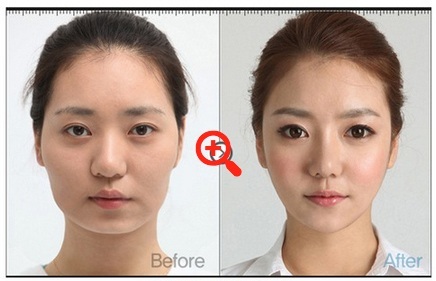

Not all ethnic groups strive to look Caucasian. Every culture has their own ideas of what makes someone beautiful. This doesn’t keep these surgeries from being any less creepy and heartbreaking. Isn’t a procedure to change one’s eye color in the same vein? Blue eyes are more valued than brown eyes in Western countries, while double eyelids are considered far superior to monolids in Eastern countries.
What’s the big deal? People get corrective laser surgery all the time, right?
How is getting laser surgery to change your eye color any different from laser surgeries that improve eyesight? I’ve looked into laser eye surgery in the past because without my glasses or contacts I’m literally a real-life Mr. Magoo. I think the main difference between these surgeries is the practicality factor. Being able to properly see the chalkboard or street lights are necessities for everyday functioning, while having blue eyes can be seen as a luxury for image-obsessed folks.
But what if having blue eyes makes someone feel better?
For me, there’s an inherent ickiness factor associated with eyelid surgeries and eye color procedures. Besides my personal disdain, I’m reminded of other cosmetic surgeries which are touted as ways to improve a person’s self-esteem or self-worth. What does it matter to me if someone feels better with blue eyes, or plumper lips, or a C-cup chest?
The thing is, I’m concerned about people who have body dysmorphic disorder. This isn’t to say everyone who undergoes cosmetic surgery has a mental illness, but having a preoccupation with a specific part of the body can’t be a healthy thing. Many times, BDD is accompanied by other symptoms like depression, anxiety, social phobia and obsessive-compulsive behaviors.
Is promoting unnecessary cosmetic procedures (like eye color changing) to groups of people who could be suffering from negative self-esteem and actual mental disorders the right thing to do? Although there are a bunch of physical characteristics that could exclude someone from taking part in the eye color procedure, what about the patients’ mental states? Is it even the duty of these health professionals to do extensive psych evaluations?
Let’s not forget, many people with darker eyes have darker complexions. Will diversity suffer from procedures like the one Homer is promoting? Is this what we want: a slew of people who are mere clones of one another?
By encouraging an aesthetic where certain traits are seen as far superior and more desirable than other traits, we’re promoting a culture where people are wrongfully ashamed of their appearance.
Let’s not have diversity suffer in the face of conformity.


